
Bird Nest in Your Dryer Vent? What to Do in Gilbert
If you're hearing flapping, scratching, or chirping from the wall behind your dryer - or you've spotted twigs and grass poking out of the vent hood outside - you almost certainly have a bird nest in your dryer vent. It's a common find on Gilbert homes, especially in spring. The short version of what to do: stop running the dryer, don't tear out what you can reach and call it done, and fix the hood flap that let the birds in. That last part is the difference between a one-time removal and an annual tradition.
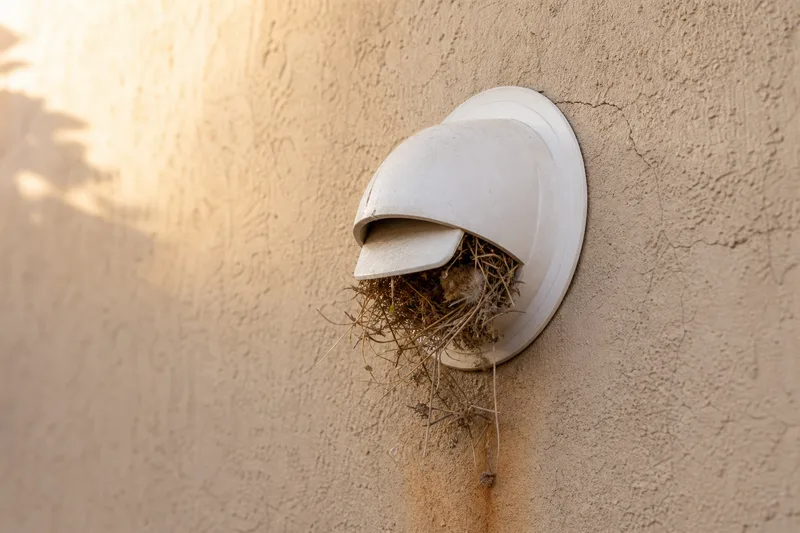
Why a dryer vent looks like prime real estate to a bird
From a bird's perspective, a dryer vent is close to ideal: a warm, elevated tube, sheltered from weather and out of reach of predators. The only thing standing between that tube and the outside world is the flap on the exterior hood. A working flap swings open when the dryer pushes air through the line and falls closed the moment it stops. When the flap fails - stuck open, cracked, or missing entirely - the duct is an open door, year-round.
That failure is common here. Exterior hoods crack and lose their flaps in the Arizona heat, and because nobody walks their exterior wall looking at vents, a flap can be gone for years before anyone notices. In established communities like Val Vista Lakes, where much of the housing stock dates to the 1980s and 90s, a stuck-open or missing flap is one of the usual findings on older homes - and an open duct is an entry point for pests. The usual movers-in are cavity-nesting birds, most often European Starlings and House Sparrows, which treat wall openings exactly like nest boxes.
How to tell it's a nest and not just lint
Three signals, in increasing order of certainty:
Sound. Flapping, scratching, or chirping from the duct or the wall cavity behind the dryer. Lint doesn't make noise.
Sight. Nesting material visible at the exterior hood - twigs, dry grass, feathers, sometimes sticking out through the opening. Walk outside and look at the termination point directly.
Performance. A sudden drop in dryer performance. This is the useful diagnostic: lint buildup is gradual, so dry times creep up over months. A nest goes in over days. If clothes dried fine last week and now take two cycles, and it's nesting season, think blockage rather than buildup.
Why removal isn't just grabbing what you can reach
What's visible at the hood can be just the outer edge of the structure. Nesting material extends back into the duct beyond what you can reach, and pulling at the visible part can compact the rest into a tighter blockage instead of clearing it. A nest also catches the lint still arriving from the dryer side, so what's actually in the line is a plug of twigs, grass, and fabric fiber sitting in the path your dryer pushes hot air through.
Then there's the verification problem, the same one that applies to DIY vent cleaning: without an airflow measurement, you can't tell "cleared" from "pushed deeper." Pulling a fistful of grass out of the hood feels like progress, but if the packed material at the first elbow stayed put, the line is still blocked and the dryer is still overheating - you've just removed the visible evidence. A proper job clears the full line from both access points, lint included, with an anemometer reading before and after so the result is a number rather than an impression. That's why nest calls are handled as a residential vent cleaning with the removal folded in - bird nests are a common find on Gilbert appointments.
The legal wrinkle: some nests are protected
Worth knowing before you reach in: under the federal Migratory Bird Treaty Act, active nests of protected native species - a nest with eggs or young in it - can't legally be removed without a permit. The two species most often found in dryer vents, the European Starling and the House Sparrow, are non-native and not covered by the Act. But that distinction only helps if you know which bird you have, and you can't identify a species by the sounds it makes inside a duct.
The practical version: if the nest is active and you haven't seen the birds, get eyes on them first - adult birds come and go through the hood while a nest is active. If it turns out to be a protected native species with eggs or young, the clean options are waiting out the nesting cycle or getting guidance from a wildlife authority, not pulling the nest blind.
Keeping birds out for good: a flap, not a screen
The fix that lasts isn't the removal - it's the hood. A termination hood in good condition has a flap (a backdraft damper) that opens under airflow and closes on its own when the dryer stops. That's the entire pest defense, and it's all the defense a dryer vent is supposed to have.
What it should never have is a mesh screen. Screening the opening is the intuitive fix, but the residential code explicitly prohibits screens at dryer duct terminations, and the reason is lint: a screen fine enough to stop birds catches lint, and a lint-caked screen chokes the vent - trading a bird problem for the exact blockage the vent exists to prevent. If a previous owner zip-tied hardware cloth over your hood, that's not protection, it's a slower version of the nest.
So if birds got into your vent, the conclusion is simple: the flap failed. Replacing the hood is the repair that actually ends the cycle, it's covered under dryer vent repair and replacement, and it's usually done in the same visit as the removal and cleaning.
The monsoon connection: same flap, second problem
A failed flap doesn't take summers off. When monsoon season arrives, the same open duct that admitted birds in spring lets storm wind push debris - leaves, seed pods, dust - straight into the line. An open duct during storm season is also shelter for pests ahead of cooler weather. Fixing the hood after a nest removal isn't just bird-proofing; it closes the door on the monsoon problem before the storms arrive.
The hood check is part of every service call - flap condition, obstruction, how it closes - so booking a removal also gets you the diagnosis of how the birds got in. If you're hearing wings in the wall, leave the dryer off and call (480) 526-5212: describe what you're hearing and seeing, and you'll have a flat-rate quote in about 60 seconds, with same-day scheduling when available.